Healthy Soch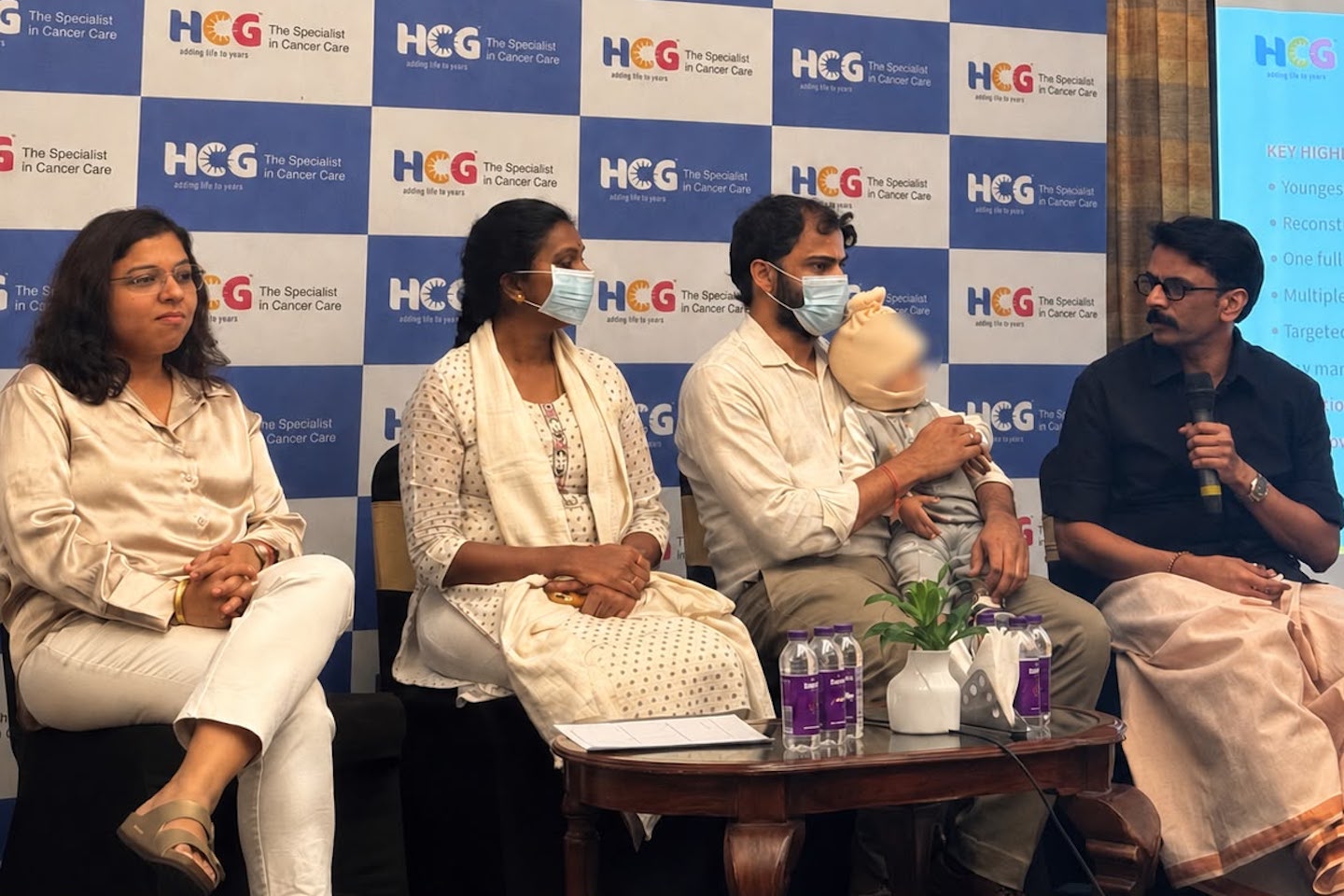
Bengaluru/New Delhi, July 15, 2026:
In a landmark achievement for oncology in orthopedics, HCG Cancer Centre, Bangalore, gave a new lease of life to a 28-day-old baby girl battling Infantile Fibrosarcoma, one of the rarest soft-tissue cancers seen in newborns. The baby was born at another hospital with a small swelling on her right forearm that grew alarmingly within days into a massive tumour measuring 11.3 cm × 9.8 cm, engulfing her tiny forearm and hand. She had already been evaluated at multiple hospitals, where amputation was suggested as the only option, leaving her parents devastated. But at HCG Cancer Centre Bangalore, a multidisciplinary team of over 14–16 super-specialists, supported by engineers and advanced planning technologies, combined their expertise to deliver a life-saving and limb-preserving treatment worth around ₹30–35 lakhs. Knowing the family was struggling financially, the hospital reached out for help, and friends, well-wishers, and the HCG team stepped in, contributing funds and support.
When the baby was brought to HCG, she was in a critical condition, with low haemoglobin, functional compromise of the limb, and a rapidly growing, fungating mass. At HCG Cancer Centre, under the guidance of Dr Pramod S Chinder, Director and Head – Orthopaedic Oncology, along with Dr Sunil Kumar H R, HOD Anaesthetist, and the plastic and reconstructive surgery team conducted a detailed assessment. The tumour was found to surround major blood vessels and nerves, making the limb extremely fragile and the surgery exceptionally high-risk. Genomic testing revealed an NTRK gene fusion, a rare genetic alteration that drives the rapid growth of cancer, with an incidence of just 0.3 per 100,000 population.
Given the complexity and rarity of the case, the HCG team consulted and discussed the treatment strategy with internationally renowned orthopaedic oncology experts, Dr Marco Manfrini and Dr Laura Campanacci, distinguished International Faculty from the Rizzoli Orthopaedic Institute, Italy. Their expert inputs helped validate the limb-salvage strategy and staged surgical approach, reinforcing confidence in pursuing a function-preserving plan for the neonate.
Given the baby’s fragile physiology and the tumour’s extreme vascularity, the treatment was planned as a multi-stage approach over one week, ensuring maximum safety at every step. The process began with a critical preparatory step led by Dr Indu Shekar, Interventional Radiologist, who performed super-selective embolisation by guiding micro-catheters through the newborn’s tiny vessels to block the tumour’s blood supply. This step was crucial as it prevented catastrophic bleeding and made the subsequent surgery significantly safer.
Simultaneously, Dr Sunil Kumar H R orchestrated an exceptionally precise neonatal anaesthesia protocol. Managing a critically ill neonate during prolonged surgery required meticulous micro-dosing, thermoregulation, and continuous haemodynamic monitoring, considered among the most challenging aspects of paediatric surgical care.
This was followed by a 7–8-hour high-precision tumour resection under the leadership of Dr Pramod Chinder. Given the microscopic size of blood vessels and nerves in a newborn, the surgery required ultra-fine dissection supported by 3D-printed planning models developed by The Purple Spark Bioengineering, Digital Twin technology, and specialised micro-instruments to achieve complete tumour removal while preserving essential structures.
Two days later, the plastic and reconstructive surgery team performed one of the youngest microvascular free flap surgeries ever reported globally. A small flap from the thigh was transplanted to the right forearm, and microvascular anastomosis was performed to re-establish blood flow and preserve long-term hand function. Post-operative wound care and meticulous monitoring ensured gradual healing.
The baby’s treatment cost approximately ₹30–35 lakhs. Nearly 300–400 individuals came together to support the family through contributions from The Yellow Ribbon (Orthopaedic Oncology Unit), HCG Foundation, AaroCare Foundation, Milap crowdfunding, doctors, hospital staff, friends, well-wishers and even around ten students who donated nearly ₹20,000 from their personal savings. This collective effort was further strengthened by the generous support of Dr. B. S. Ajaikumar and family, HCG Foundation and HCG Cancer Hospital, Ms. Manisha Kumar, Dr. Pramod S. Chinder and his family through the AaroCare Foundation, Mrs. Ratnamma Shekarappa, Mrs. Geeta Swami, and Dr. Krithika Murugan and family, whose contributions ensured that financial constraints never delayed the newborn’s life-saving treatment.