Healthy Soch
- Manuscripts provide evidence of human activity: “Gyan Bharatam Mission’
- Manuscripts are an incomparable civilisational treasure: Gyan Bharatam Mission, Ministry of Culture , Government of India
India
healthysoch
Chandigarh, May 13, 2026:
Under the flagship initiative of the Ministry of Culture ( MoC) , Government of India , “Gyan Bharatam Mission” , the topic ‘ Prevention and Conservation of Manuscripts’ will be discussed. A five-day workshop on this is being organised at Patanjali Research Foundation , Haridwar . National Mission on Manuscripts , It is a symbol of ‘ Jnana Bharatam ‘ . The primary objective of this mission is to preserve, document and digitise India’s invaluable and vast manuscript heritage. So that this ancient knowledge-wealth can be preserved for future generations.
This workshop was organised with the aim of creating awareness about manuscript conservation and developing storage-related skills. Officials, experts and various representatives of the Ministry of Culture, Government of India, participated in the programme. The programme was inaugurated with Yaj and lighting of lamps. The distinguished guests were welcomed by presenting shawls, garlands and mementos. The welcome address was given by Dr. Vedpriya Arya, Head of Patanjali Research.
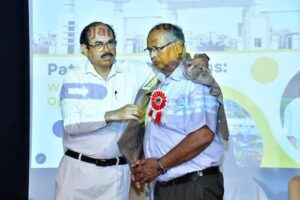 Dr Anupam Srivastava, Vice President of Patanjali Research Foundation, ‘Flora’: A systematic description of the plants found in a particular region or time. Published in book form, it provides scientific data. There are also journals with this name, such as Flora . Published biological research. In this context, Dr Ram Swarup, farmer and deputy director of archives at the National Archives of India, stated that manuscripts are handwritten records that provide important evidence of human activities and historical events. They encompass diverse scripts, themes , languages, artistic structures, aesthetics, ornamentation, and illustrations. Manuscripts come in many types, particularly those on stone, palm leaves, copper plates, birch bark, and gold leaves. He noted that hundreds of years old manuscripts engraved on palm and birch leaves are housed in museums in India and libraries worldwide.
The objective of this workshop is to ensure the identification, preservation, and public accessibility of manuscripts across the country. Currently, this invaluable heritage is in danger, so the National Manuscript Mission is continuously working to preserve and enhance manuscripts held in institutional and private collections. Both chemical and traditional methods are used to preserve manuscripts. They are preserved in acid-free boxes to protect them from moisture, dust, sunlight, and insects, and a balanced temperature, humidity, and natural materials are used. Special storage and multi-layered security measures are necessary to protect manuscripts from natural disasters such as fire , floods, and earthquakes.
Prof. Anirvan Das, Project Director, Gyan Bharatam Mission, Ministry of Culture, Government of India, New Delhi, stated that all three dimensions—language, script, and content—are preserved and promoted with seriousness and interest. So far, 7.5 million manuscripts have been registered for long-term preservation. He explained that under Gyan Bharatam, work will be carried out in five key areas: linguistics, survey, research and publication, digitisation, and text analysis. The Honourable Prime Minister considers manuscripts to be an invaluable asset of India’s rich knowledge tradition, culture, and civilisation. According to him, these are not just ancient documents but living evidence of India’s consciousness, scientific vision, and philosophical heritage. Two hundred ‘manuscripts’ were correlated with artificial intelligence (AI).
Chand Mohan Joshi (ASI) explained that the “Astasahasrika Prajnaparamita” is an extremely ancient and important text of Mahayana Buddhism , meaning the perfection of wisdom in eight thousand lines. This text explains the path of the Bodhisattva and the concepts of emptiness and nirvana and is also known as “Buddhamata”. He added that the Government of India is implementing the “Jnana Bharatam Mission” to preserve and digitise ancient texts. In his lecture on indigenous materials, he explained that in ancient India, natural materials such as palm leaves , birch bark , copper plates, cloth, and leather were used to write and preserve manuscripts. These materials reflect the richness of India’s knowledge tradition and cultural heritage. Dr Rashmi Mittal, Scientist and Head, History and Archaeological Research Division, explained that the Ethiopian manuscripts are primarily religious-cultural works written on parchment in the Ge’ez language, dating from the 14th to the 20th centuries, and feature beautiful illustrations. These belong to the Ethiopian Orthodox Church , the oldest of which is the “Garima Gospel”, an important illustrated manuscript from the fourth to sixth centuries.
He further mentioned the Sushruta Samhita, stating that its oldest copy is a palm leaf manuscript dated 878 AD, preserved in the Kaiser Library in Nepal , which provides detailed descriptions of surgery. Furthermore, Hastinapur was the capital of the Kuru Kingdom during the Mahabharata period and is considered the birthplace of the Pandavas and Kauravas , with a very ancient history. Dr. Mamta Mishra , art conservator , restorer, and instructor, and former Director of the INTACH Institute of Conservation , Lucknow, stated that promoting the conservation of traditional heritage is essential to preserve our cultural identity , history, and values. She also emphasized the need to integrate traditional materials and skills with modern technology in the conservation of ancient monuments. Dr Vedpriya Arya, introducing the concepts of heritage , culture and conservation, said that heritage, culture, and conservation are words that connect a society’s identity, history, and future. Patanjali is leading with this vision and mission.
In his vote of thanks, Dr Anupam Srivastava, Vice President of Patanjali Research Foundation, told the scientists and scholars that such seminars provide new knowledge. Senior officials and representatives of the ministry also welcomed Patanjali. The Herbal Garden and Research Center was visited, and their efforts were praised. The programme concluded with a vote of thanks to the guests and participants.